
The Importance of Prep
Good prep solves the problems that become expensive once the full cast and crew are already standing on set.
The Problem
Some productions treat prep like wasted money because the camera is not rolling yet. They see prep days as cost before anything ends up on screen.
That is a dangerous way to look at production. Prep is not the expensive part of the job. The shoot day is. During prep, only a few key people are usually being paid to solve problems before the full cast, crew, trucks, locations, equipment are on the clock.
When prep is reduced, the problems do not disappear. They move onto the shoot day, where every minute costs more and the time available to shoot gets smaller.
The Real Cost of Prep
Prep looks expensive when it is judged by itself. But compared to a shoot day, prep is usually the cheapest time to solve expensive problems.
A few people can make calls, scout, adjust the schedule, confirm access, answer department questions, and make creative decisions before the crew arrives. On the shoot day, the full production and cast are waiting while those same decisions get made.
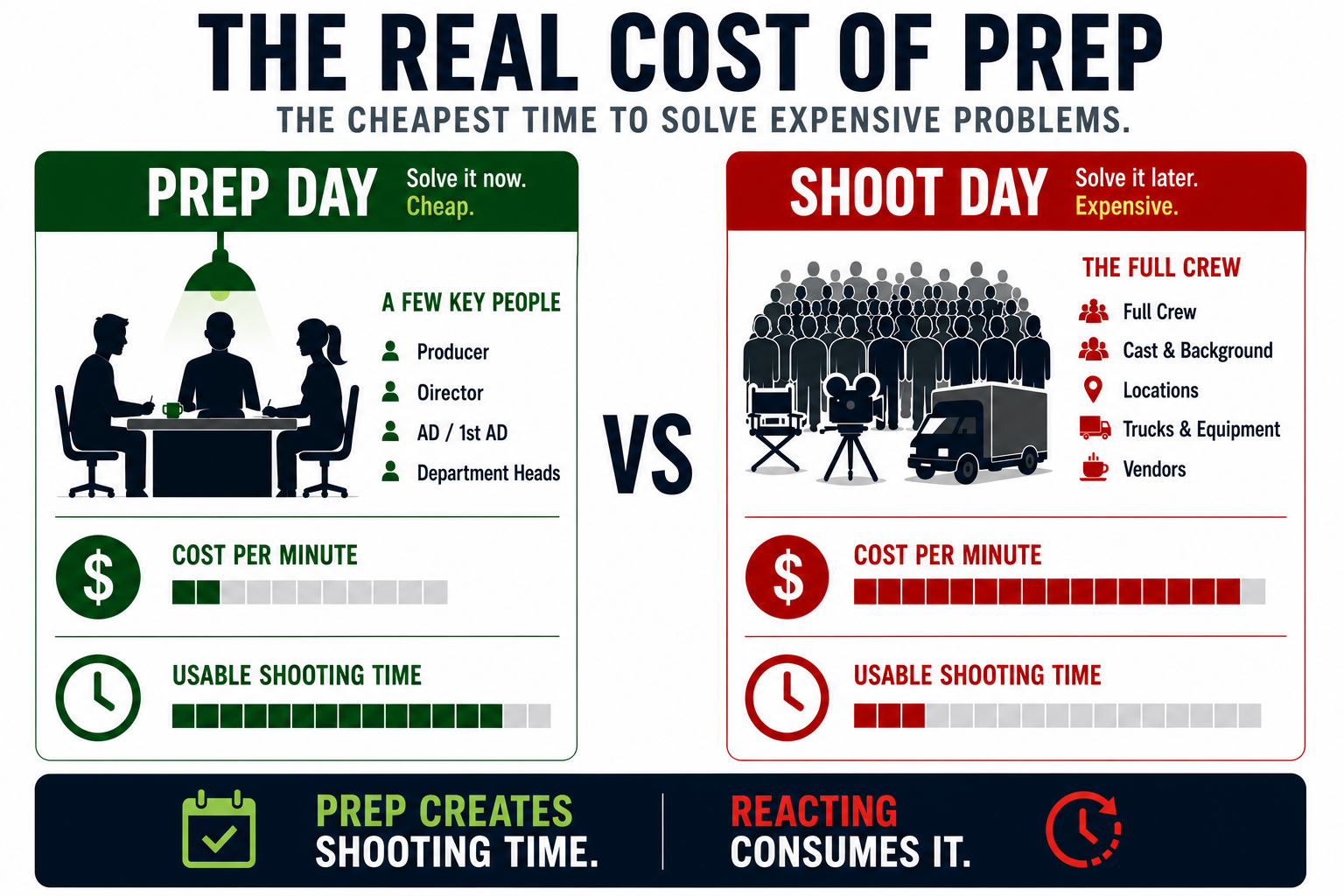
Prep creates shooting time. Reacting consumes it.
Prep Is Cheaper Than the Shoot Day
The reason prep matters is simple: not everyone is being paid yet. A prep day may involve a producer, director, AD, department heads, scouts, calls, emails, revisions, and planning. A shoot day involves everyone and everything.
Once production is shooting, every unresolved problem becomes more expensive. Parking is not just a parking problem anymore. It becomes a delay. A missing holding area is not just a logistics issue anymore. It slows down cast, background, ADs, departments, and the next setup.
Inexperienced producers often cut prep because they think the money does not appear on screen. In reality, prep creates the conditions that allow more of the shoot day to end up on screen.
The goal of prep is not to spend more. The goal is to avoid paying shoot-day prices for problems that could have been solved earlier.
Prep Creates Shooting Time
The goal is to create the conditions that allow the camera to roll more often during the shoot day.
When the crew arrives and parking, holding, staging, restrooms, meals, communication, company moves, creative decisions, blocking, and department questions are already handled, the day can move toward shooting faster.
When prep is skipped, the shoot day becomes the prep day. The difference is that now the full production is on the clock and needs to be paid.
That is why cutting prep can look like a savings on paper at first while quietly reducing the amount of usable shooting time the production actually gets.
Operational Prep Nobody Thinks About
Many productions spend all of prep focused on the set that needs to be shot. The set matters, but the production also needs somewhere for people to park, somewhere to hold cast and background, somewhere to stage equipment, somewhere to eat, and somewhere to use a restroom.
A beautiful location is not automatically a good production location. If nobody can park, unload, stage equipment, find a restroom, hold background, or move departments efficiently, the location will cost far more time than expected.
- Check parking before the shoot day
- Plan truck access and load-in routes
- Identify holding areas for cast and background
- Plan equipment staging areas
- Confirm restroom access
- Confirm lunch and meal areas
- Verify walkie coverage and communication plans
- Think through crew movement between setups
How Poor Prep Shows Up on Set
Weak prep does not stay hidden. It shows up as delays, repeated questions, rushed decisions, extra costs, safety concerns, stress, and departments becoming reactive.
When something was not prepped properly, the shoot day has to absorb it. That means the crew loses time that should have been spent shooting, rehearsing, lighting, blocking, or working with the actors.
- Locations are harder to work in than expected
- Company moves take longer than planned
- Departments need answers while the day is already in motion
- Creative decisions get rushed under pressure
- Background and cast are hard to find
- Equipment has nowhere to stage
- The AD team has to solve prep problems on the floor
- The production starts paying for decisions that should have been made earlier
- The shoot day becomes a more expensive version of the prep day
Prep Creates Trust
Good prep does more than solve logistical problems. It gives the cast and crew confidence that the production is organized and ready.
When parking is clear, meals are planned, locations are ready, call sheets are accurate, and department information is easy to understand, people can focus on their work instead of wondering what has been forgotten.
That confidence creates trust. Trust allows departments to anticipate instead of constantly checking, chasing, or reacting to missing information.
Crews can handle hard days. What wears people down is feeling like the hard day was avoidable because the basic prep was never done.
Why Smooth Productions Feel Easy
The best productions often feel calm because the hard work happened before the crew arrived. Parking was figured out. Restrooms were handled. Walkies were working. Holding was clear. Meals were planned. Company moves were realistic. Creative decisions had been discussed. Departments knew what was coming.
Audiences never see that work. They only see the finished show. But on set, the difference is obvious. The smoother the shoot day feels, the stronger the prep was.
Prep is not wasted money. It is the cheapest place to solve problems before they become expensive shoot-day delays.
Have we taken every possible problem in account that could create delays on the shoot day?