
Slow Is Smooth. Smooth Is Fast.
On set, speed does not come from pushing. It comes from clean work, fewer mistakes, fewer resets, and a crew that understands the scene before the camera rolls.
The Problem
A lot of productions confuse rushing with moving fast. They start pushing harder, talking louder, cutting corners, and demanding speed from departments that are already trying to keep up.
The problem is that rushed work often creates more work. A rushed camera setup, rushed blocking, or rushed lighting setup can create mistakes that cost more time than doing the work properly the first time.
What It Really Means
“Slow is smooth, smooth is fast” does not mean work slowly. It means respecting the process enough that the crew does not have to stop, fix, reset, explain, redo, or recover.
A smooth crew may not look frantic, but they are usually moving faster than the crew that is running around putting out fires. The smooth crew has fewer interruptions. The rushed crew loses time because it is constantly reacting.
- Rushing creates mistakes
- Mistakes create corrections
- Corrections create lost time
- Lost time creates pressure
- Pressure creates more mistakes
- Smooth work breaks that cycle
Set Mechanics
A set is not fast because people skip steps. A set is fast because the steps happen in the right order.
When a new scene starts, the first move is often to clear the set. Cameras, stands, lighting equipment, and anything that restricts movement should be pulled back when possible. That gives the director, DP, and actors a clean space to find the scene.
That free space matters. The director needs to see the actors move. The DP needs to see where the scene wants to be shot from. The actors need enough room to discover the blocking. If camera and lighting are already planted in the way, the blocking starts bending around equipment instead of the scene.
Before blocking, the scene should also be physically ready. Props that are needed should be present. Set pieces that need to move should be placed. Anything obvious that can be pre-lit around the set that does not restrict movement on set should be put in place. If something needs to be hung and it is clear it will not move, that work can happen before director and actors walk onto set.
That does not mean the crew is wasting time. It means the set is being prepared so the important decisions can happen cleanly and smoothly.
Respect The Order
Once the space is ready, the director can bring in the actors and block the scene. This is where movement, dialogue, eyelines, geography, and rhythm get worked out.
From the outside, this can look slow. But this is where valuable shooting time is created. If the blocking is unclear, everything after it becomes reactive. Lighting changes. Camera positions change. Set pieces move. Background gets adjusted. Shots stop connecting.
After the blocking is dialed in, the director can run the scene for the crew. Now the DP, AD team, camera, grip, electric, sound, art, props, wardrobe, and hair and makeup can all see what is actually about to happen.
That run-through creates shared information. The crew sees the first shot, the likely second shot, and what the reverse shot or turn-around will look like. They are no longer guessing. They can anticipate.
- Clear the set so the scene can be found
- Stage the props and important set pieces before blocking
- Pre-light without restricting the set
- Block the scene with the director, DP, and actors
- Run the scene for the crew
- Remove cast for last looks while departments prepare the first shot
- Let camera, grip, and electric work while cast gets their touch-ups
Shot-Driven Work vs Scene-Driven Work
Many inexperienced productions think they are saving time by setting up the first shot immediately. It feels productive because the camera is up, the frame is being discussed, and something visible is happening.
But if the scene has not been properly blocked, the production often ends up building the scene one shot at a time. Shot one gets blocked, lit, adjusted, and shot. Then shot two needs new blocking, new lighting, new camera movement, new prop adjustments, and another reset. Then shot three starts the same cycle again.
That creates no flow. Every shot becomes its own small production problem. The crew is not moving through the scene. The crew is rebuilding the scene over and over again.
Experienced crews usually work from the scene first. Once the blocking is understood and the crew has seen the action, departments can anticipate multiple shots instead of reacting to one shot at a time.
This creates a much better flow on set and also a much better flow inside the shots, which creates a stronger flow when the scene is edited together.
The goal is not to get the first shot faster. The goal is to get through the entire scene with as few setups as possible while still capturing the scene well.
- Shot-driven work resets the scene over and over
- Scene-driven work lets departments understand the whole scene
- Blocking first creates a plan for shot coverage
- Lighting can support multiple angles instead of one rushed frame
- Camera can prepare for the scene instead of chasing every change
- The crew can move through coverage with less setups
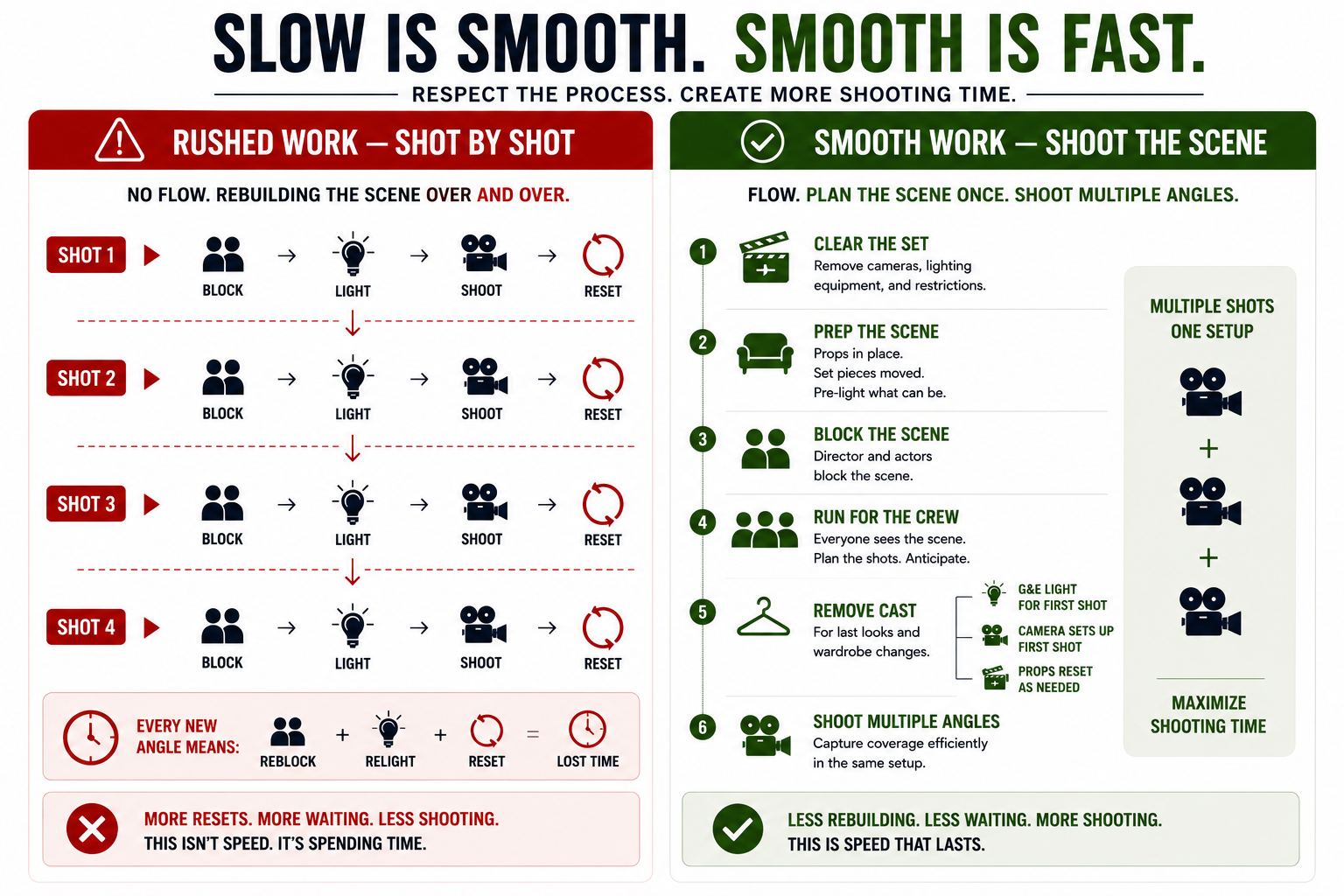
Block once. Plan once. Shoot multiple angles. Less setups means more usable shooting time.
Why Smooth Crews Move Faster
The best crews know the order of operations. They communicate clearly. They do not make every department wait while one person figures out what should have been decided earlier.
Smooth crews are not casual. They are prepared. They know what is coming next, and they solve problems before the whole set has to feel them.
The real advantage of smooth crews is anticipation. They are not only working on the thing in front of them. They are preparing the next step while the current step is still happening.
While cast is in last looks, grip and electric can light the first shot. Camera can be placed for the first setup. Props can reset what was just blocked. The AD team can prepare background and get ready for the next setup.
Because the crew watched the blocking, they are not reacting to random instructions. They understand the scene. They know where the first shot is going, what the next shot may be, and where to stage or set up equipment.
- Props are ready because the crew knows what is being used
- Wardrobe and hair/makeup know when cast is needed back
- The AD team can move people and facilitate departments without stopping the set
- Departments work in parallel instead of waiting in sequence
Experience Creates Smoothness
Smooth productions are rarely an accident. They are usually the result of experienced people making good decisions before problems become visible.
An experienced AD sees the bottleneck before the crew has to deal with it. An experienced DP understands what coverage will likely be needed before the first shot is framed. An experienced key grip knows what equipment will be needed later and stages it nearby before anyone has to ask.
That is why experience is not only about doing the job well. It is about seeing the next problem early enough to keep it from becoming a delay.
The value of experience is anticipation. Anticipation creates more shooting time. And more shooting time is where the production gets its best value.
- Experience reduces guessing
- Experience prevents unnecessary resets
- Experience helps departments prepare ahead
- Experience protects the day when the schedule gets tight
- Experience turns pressure into better decisions instead of more chaos
What Happens When The Order Is Ignored
Inexperienced productions often think putting the camera up first will save time. It can feel productive because something visible is happening.
But if the camera is set before the blocking is understood, the set starts working backwards. The camera may restrict where actors can move. Lighting may be built for blocking that changes five minutes later. Stands, carts, and equipment may sit exactly where the scene needs to take place.
The production may get one or two shots quickly, but then the problems start. The shots do not connect. The geography does not work. The actor movement changes. The lighting needs to be adjusted. Camera has to move again. Everyone waits while the set repairs a problem the proper process would have prevented.
That is why rushed work often contains waiting time inside the shooting time. The schedule may say the production is shooting, but the crew is really solving problems created by skipping the set mechanics.
- Camera gets set before the scene is blocked
- Blocking changes because the space is restricted
- Lighting has to be adjusted again
- Shots stop connecting cleanly
- Departments wait while the setup is adjusted
- Shooting time becomes problem-solving time
The Real Production Lesson
Speed is not the same as urgency. Urgency can help when a production is getting behind schedule, but it cannot replace prep, communication, and clean execution.
A calm, organized set can move incredibly fast because departments are not constantly recovering from mistakes. That is why experienced crews often say: take your time, don't run.
Smooth work respects the mechanics of the set. It creates room to block, room to light, room to shoot, and room for every department to anticipate what is coming next.
Respecting the process creates anticipation. Anticipation creates flow. Flow creates more shooting time.
And more shooting time is where a better movie is made.
The crew that appears slower for the first ten minutes is often faster for the next ten hours.
Are we creating usable shooting time, or are we creating problems we will have to solve while the clock is running?