
Why Overtime Is So Expensive
Longer days do not always mean better days. At a certain point, productivity drops, quality suffers, costs climb, and tomorrow becomes harder before it even starts.
The Problem
Many productions assume more hours means more pages. That is not always true. The first part of the day is usually the sharpest. The last part of a long day is often the slowest, most expensive, and most dangerous part of the shoot.
A crew can push through a long day, but productivity is not linear. As the day gets longer, people move slower, communicate worse, make more mistakes, and stop anticipating as clearly.
The Productivity Curve
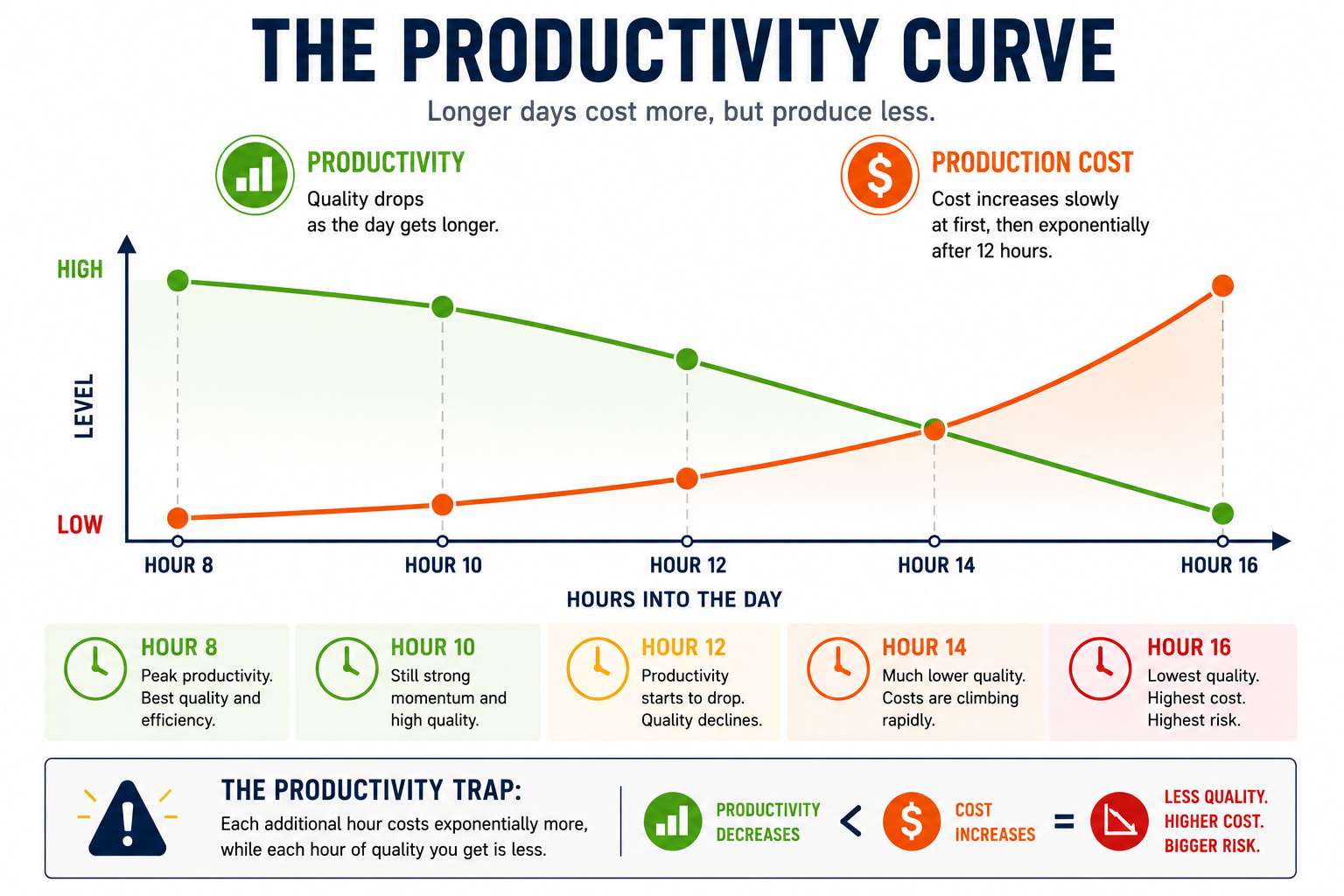
A crew does not perform at the same speed all day. Early in the day, departments are sharper, communication is cleaner, and decisions usually move faster.
Later in the day, the work gets heavier. Setups take longer. Mistakes increase. Quality becomes harder to maintain. The production may still be shooting, but the value of each additional hour starts to drop.
That is the productivity trap. The day keeps getting more expensive while the work becomes slower, heavier, and less reliable. After twelve hours, the cost curve can rise fast while quality and efficiency continue to fall.
The goal is not simply to make the day longer. The goal is to create as much usable shooting time as possible while the crew is still operating at its best.
8, 10, 12, 14 and 16-Hour Days
An 8-hour day keeps most crews sharp. A 10-hour day is often a very efficient production day. A 12-hour day is common in film and can work well with a strong crew and a realistic schedule.
After that, the math starts changing. A 14-hour day may look like two more hours of shooting, but those hours are usually slower, more expensive, and harder on quality. A 16-hour day is survival mode. By that point, most crews are operating on discipline, habit, and determination.
- 8 hours: sharp crew, strong quality, high efficiency
- 10 hours: still strong momentum and good pace
- 12 hours: workable, but productivity starts to drop
- 14 hours: lower quality, slower setups, rising cost
- 16 hours: lowest quality, highest cost, highest risk
- The longest day is never the most productive day
Why Overtime Gets Expensive Fast
The mistake is thinking two extra hours gives you two clean hours of production. It usually does not. By the time overtime hits, the crew is tired, communication is weaker, and departments are moving slower.
The production pays more for those hours, but the work coming out of those hours is often less efficient. That is how overtime becomes expensive twice: first in payroll, then in lost pace, lower quality, and more mistakes.
- Late-day setups usually move slower
- Fatigue creates more resets and mistakes
- Actors may need more takes late in the day
- Departments stop anticipating and start reacting
- Quality becomes harder to maintain
- The crew may finish the day, but tomorrow starts weaker due to fatigue
The Hidden Cost Is Tomorrow
Most producers calculate today’s overtime. They forget what it does to tomorrow. A very long day can slow down the next morning before the crew even gets to set.
The crew arrives tired. The first setup takes longer. Communication is slower. Morale drops. People are less patient. That is how one bad overtime day can bleed into the next two or three days.
- Turnaround gets tighter
- The next morning starts slower
- Departments make more mistakes
- Safety risk increases after wrap
- Morale drops when long days become the norm
- The production loses productivity twice: today and tomorrow
Why Good ADs Protect the Front of the Day
Good ADs know the most valuable hours are the early hours. That is why strong productions fight hard for a clean start, ready cast, complete prep, working walkies, clear transportation, breakfast, and departments that know what is next.
You do not want to be trying to save the day in hour fourteen. You want to make the day in hours one through eight, while the crew is still sharp and the set still has rhythm.
- Get the first shot up cleanly
- Keep cast ready before the set is waiting
- Pre-light when possible
- Keep transportation and parking from slowing the morning down
- Make sure the crew is fed before the hard part of the day
Overtime Usually Starts Before Call Time
Most overtime is not created at hour twelve. It is created during prep.
Unrealistic page counts, too many company moves, difficult locations, incomplete prep, understaffed departments, and underestimated scenes all make the day harder before the crew even arrives.
By the time a production reaches overtime, the problem often started much earlier. Overtime is usually the symptom. The real cause is somewhere in the approach.
- Too many pages for the day
- Too many locations
- Company moves at the wrong time of day
- Scenes more complex than the schedule assumes
- Incomplete or bad prep
- Schedules built on best-case assumptions
The Experienced Crew Factor
You do not always need every person on the crew to be the most experienced person available. But a few experienced people in the right positions can change the entire schedule.
On a fast shoot, the biggest schedule impact often comes from the director, 1st AD, and DP. Those people can remove waste, keep decisions moving, reduce resets, protect coverage, and stop the day from turning into overtime.
- A strong director knows when the scene is done
- A strong 1st AD can save 30 to 60 minutes a day
- A strong DP can reduce setup time and improve shot efficiency
- Experienced crew members anticipate instead of waiting to be told
The Real Production Lesson
Overtime is not automatically bad. Sometimes the production needs it. Sometimes staying late is the right call. But overtime should be a choice, not the plan.
If every day depends on overtime, the schedule is probably lying. A well-run 10 or 12-hour day can often protect more quality than a poorly run 14-hour day. The productions that make their days are usually not the ones working the longest. They are the ones that are best prepared.
Preparation creates smoothness. Smoothness creates productivity. Productivity protects quality and prevents overtime.
The most expensive hours of the day are often the least productive.
Did overtime happen because the crew was slow, or because the schedule was already too tight?